Oil-Free Vacuum
PTFE Chemical Resistant
15-120 L/min
15-250 mbar
Continuous 24h Operation
Availability: In Stock


Oil-Free Vacuum
PTFE Chemical Resistant
15-120 L/min
15-250 mbar
Continuous 24h Operation
Availability: In Stock
A PTFE diaphragm vacuum pump is the preferred oil-free vacuum source for vacuum filtration, corrosive solvent evaporation, HPLC filtration and SPE workflows because it combines chemical resistance, stable vacuum and low maintenance.
For most laboratory vacuum filtration, a diaphragm vacuum pump with 15-50 mbar ultimate vacuum is sufficient.
For rotary evaporation involving dichloromethane, acetone, tetrahydrofuran (THF), ethyl acetate, or acidic vapors, we recommend selecting the corrosion-resistant PTFE models (11271003/05/07/09/11/12).
For high-throughput laboratories or multiple evaporation systems, choose 60-120 L/min high-flow models to maintain stable vacuum during continuous operation.

A diaphragm vacuum pump uses a flexible membrane driven by an eccentric motor to create vacuum without oil lubrication. Compared with rotary vane oil pumps, diaphragm pumps provide cleaner vacuum, lower maintenance requirements and better compatibility with laboratory solvents.
Diaphragm vacuum pumps are widely used for:
A PTFE diaphragm vacuum pump is especially suitable for solvent evaporation involving dichloromethane (DCM), acetone, tetrahydrofuran (THF), ethyl acetate and acidic vapors because PTFE air paths resist swelling and chemical degradation.
| Application | Recommended Model | Reason |
| Rotary evaporator with DCM or THF | 11271012 | 15 mbar PTFE model for aggressive solvents and fast evaporation. |
| Routine ethanol or methanol evaporation | 11271006 | 50 mbar vacuum sufficient for standard laboratory evaporation. |
| HPLC solvent filtration | 11271002 / 11271004 | Stable vacuum with low operating cost. |
| SPE manifold systems | 11271008 / 11271009 | Higher flow stabilizes extraction pressure across multiple channels. |
| Multiple rotary evaporators | 11271010 / 11271011 | 120 L/min high-flow design supports multiple systems simultaneously. |
| Corrosive solvent laboratories | 11271003 / 05 / 07 / 09 / 11 / 12 | PTFE-coated air paths resist chemical corrosion. |
Step 1: Are corrosive solvents used?
–YES: Select PTFE anti-corrosion models.
–NO: Standard diaphragm pumps are sufficient.
Step 2: Is rapid evaporation or low-temperature evaporation required?
–YES: Select 15-50 mbar models.
–NO: 200 mbar models are usually adequate.
Step 3: Are multiple instruments operated simultaneously?
–YES: Choose 60-120 L/min high-flow models.
–NO: 15-30 L/min models are normally sufficient.
Vacuum instability during solvent evaporation is usually caused by four engineering problems:
For low-boiling solvents such as dichloromethane, insufficient chemical resistance may lead to diaphragm swelling and unstable vacuum performance.
Hawach PTFE diaphragm pumps incorporate chemically resistant air paths and cooling structures that reduce solvent-related pressure fluctuation during continuous evaporation.
| System Component | Function | Engineering Recommendation |
| Diaphragm Vacuum Pump | Generate stable vacuum | 11271012 PTFE model recommended for corrosive solvents. |
| Cold Trap / Condenser | Protect pump from solvent vapor | Dry ice condenser recommended for DCM and THF. |
| Vacuum Controller | Prevent bumping and foam overflow | PID pressure control improves reproducibility. |
| Chemical Resistant Tubing | Prevent leakage and collapse | PTFE or butyl rubber tubing recommended. |
| Problem | Likely Cause | Recommended Solution |
| Violent bumping during evaporation | Vacuum applied too quickly | Reduce pressure gradually or use vacuum controller. |
| Pump corrosion after several months | Using standard diaphragm with aggressive solvents | Upgrade to PTFE anti-corrosion models. |
| Slow evaporation speed | Insufficient vacuum depth or flow rate | Use 15 mbar or higher-flow models. |
| Unstable vacuum reading | Solvent condensation inside pump head | Install cold trap before pump. |
| Inconsistent SPE extraction flow | Vacuum fluctuation | Use higher-flow pump or reservoir buffer. |
Reducing pressure lowers solvent boiling point, enabling low-temperature evaporation of heat-sensitive compounds.
This principle allows efficient solvent removal for natural products, peptides and pharmaceutical intermediates without thermal degradation.
Internal engineering test data available upon request.
| Feature | Diaphragm Pump | Water Jet Pump | Rotary Vane Oil Pump |
| Oil-free operation | Yes | Yes | No |
| Chemical resistance | High | Medium | Low |
| Maintenance cost | Low | Medium | High |
| Ultimate vacuum | 15-250 mbar | ~50 mbar | <1 mbar |
| Best application | Rotary evaporation, filtration, SPE | Aqueous vacuum work | Ultra-high vacuum systems |
Solvents that damage standard diaphragms:
Acetone, dichloromethane, THF, ethyl acetate, toluene, xylene and dilute acids can gradually degrade conventional rubber diaphragms.
Hawach PTFE models (11271003 / 05 / 07 / 09 / 11 / 12) use PTFE-coated air paths and PTFE diaphragms to resist chemical attack during long-term solvent exposure.
Standard models remain suitable for water, methanol, ethanol and mild buffer solutions.
| Cat. No. | PTFE | Flow (L/min) | Ultimate Vacuum | Power (W) | In/Out (mm) | Pump Head | Dimensions (mm) | Weight (kg) |
| 11271001 | No | 15 | 250 mbar | 75 | Φ6 | Nylon | 195×98×156 | 4 |
| 11271002 | No | 20 | 200 mbar | 160 | Φ6 | 1 | 210×120×235 | 7.5 |
| 11271003 | Yes | 20 | 200 mbar | 160 | Φ6 | 1 | 210×120×235 | 7.5 |
| 11271004 | No | 30 | 200 mbar | 160 | Φ6 | 1 | 210×160×235 | 8 |
| 11271005 | Yes | 30 | 200 mbar | 160 | Φ6 | 2 | 210×160×235 | 8 |
| 11271006 | No | 30 | 50 mbar | 160 | Φ6 | 2 | 300×120×235 | 10 |
| 11271007 | Yes | 30 | 50 mbar | 160 | Φ6 | 2 | 300×120×235 | 10 |
| 11271008 | No | 60 | 200 mbar | 160 | Φ6 | 2 | 300×160×235 | 10 |
| 11271009 | Yes | 60 | 200 mbar | 160 | Φ6 | 2 | 300×160×235 | 10 |
| 11271010 | No | 120 | 200 mbar | 300 | Φ9 | 2 | 390×150×250 | 20 |
| 11271011 | Yes | 120 | 200 mbar | 300 | Φ9 | 2 | 390×150×250 | 20 |
| 11271012 | Yes | 30 | 15 mbar | 160 | Φ6 | 2 | 370×144×275 | 13.5 |
Best overall for corrosive solvents & fast evaporation: 11271012
Best for routine aqueous/alcohol rotary evaporation: 11271006
Best for high throughput laboratories: 11271010 / 11271011
Best value for filtration & general laboratory use: 11271002 / 11271004
The most common reason is solvent condensation inside the pump head. A cold trap between the evaporator and pump is strongly recommended.
For most laboratory solvents, 15–50 mbar is sufficient. Ultra-high vacuum applications below 1 mbar require rotary vane oil pumps.
Yes. Vacuum controllers improve reproducibility and reduce bumping during solvent evaporation.
DCM has very high vapor pressure. Begin evaporation around 300 mbar and gradually reduce pressure.
Under continuous laboratory use with solvents such as acetone or DCM, PTFE diaphragms typically last 2–3 years.
Send your solvent list, evaporation scale and application requirements – Hawach engineers will recommend the most suitable diaphragm vacuum pump model for your workflow.
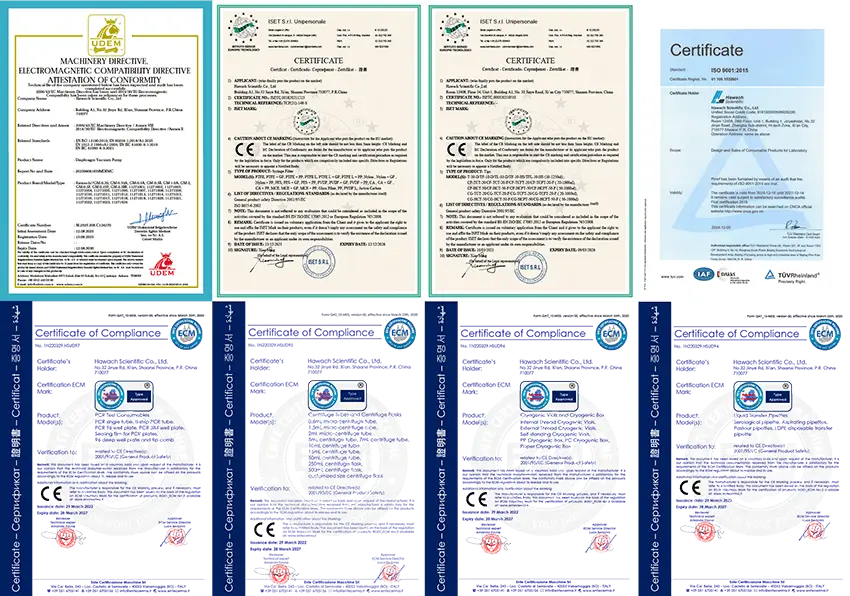

The quality has a guarantee

Fast & safe shipping worldwide


