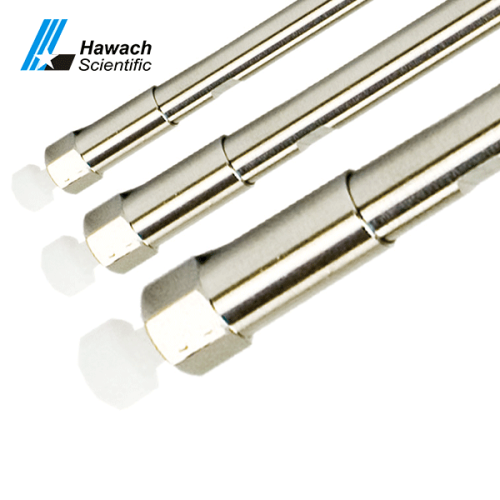
USP L43
3 μm / 5 μm
120Å
Orthogonal Selectivity to C18
Enhanced Retention for Aromatic & Halogenated Analytes
Availability: In Stock


USP L43
3 μm / 5 μm
120Å
Orthogonal Selectivity to C18
Enhanced Retention for Aromatic & Halogenated Analytes
Availability: In Stock
A PFP HPLC column (pentafluorophenyl column, also known as F5 column) is a specialized reversed-phase column (USP L43) designed to provide alternative selectivity for compounds that are poorly retained or insufficiently resolved on conventional C18 columns.
The stationary phase consists of a pentafluorophenyl (C₆F₅) ligand bonded to ultra-high purity fully porous spherical silica. Unlike standard hydrophobic C18 phases, the electron-deficient pentafluorophenyl ring introduces multiple retention mechanisms including:
This mixed-mode retention behavior makes PFP columns particularly effective for:
Hawach PFP HPLC columns are manufactured from >99.999% pure Type B spherical silica with controlled bonding density for high reproducibility and consistent selectivity across batches. Each production lot is QC-tested using a standard reference mixture to verify retention, efficiency, and peak symmetry.
Available particle sizes:
Available dimensions include:
Column lengths available from 30 mm to 300 mm.
Many analytes that co-elute on conventional C18 columns can often be resolved on a PFP phase because the selectivity mechanism is fundamentally different.
| Feature | PFP (Pentafluorophenyl) Column | Standard C18 Column |
| USP classification | L43 | L1 |
| Primary retention mechanism | Mixed-mode: π-π, dipole, H-bond, hydrophobic | Primarily hydrophobic |
| Aromatic isomer selectivity | Excellent | Moderate |
| Halogenated compound retention | Strong | Limited |
| Polar analyte retention | Enhanced | Often weak |
| Orthogonal selectivity | Yes | Reference phase |
| Method development value | Excellent secondary screening phase | Primary general-purpose phase |
Key takeaway: PFP columns are not intended to replace C18 universally. They are most valuable when conventional C18 phases fail to resolve critical analyte pairs or provide insufficient selectivity during method development.

| Application | Recommended Part No. | Particle Size | ID × Length | Why |
| Routine HPLC analysis, general method development | 13021315 | 5 μm | 4.6×250 mm | Standard analytical format with balanced runtime and resolution |
| Faster analysis / UHPLC | 13021277 | 3 μm | 4.6×250 mm | Higher efficiency and reduced runtime |
| LC/MS analysis | 13021246 or 13021248 | 3 μm | 2.1×100 mm or 150 mm | MS-compatible low flow rates |
| Method development screening | 13021275 or 13021313 | 3 μm or 5 μm | 4.6×150 mm | Faster scouting and selectivity evaluation |
| Preparative purification | Contact sales | 5 μm | 7.8 mm ID or larger | Increased loading capacity |
13021315 — PFP, 5 μm, 120Å, 4.6×250 mm
Most commonly used configuration for analytical HPLC and method transfer applications. Standard inventory item with 3-5 business day lead time.
| Particle Size | Best For | Typical Pressure | Typical Runtime |
| 3 μm | UHPLC, fast analysis, LC/MS | ≤6000 psi | Shorter |
| 5 μm | Conventional HPLC, routine QC | ≤4000 psi | Standard |
| Parameter | Value |
| USP classification | L43 |
| Bonded phase | Pentafluorophenyl (C₆F₅) |
| Particle sizes | 3 μm, 5 μm |
| Pore size | 120Å |
| Surface area | ~300 m²/g |
| Carbon load | ~10% |
| Silica type | Ultra-high purity Type B silica |
| pH range | 2.0 – 8.0 |
| End-capping | Double end-capped |
| Max pressure | ~6000 psi (3 μm); ~4000 psi (5 μm) |
| Temperature limit | ≤60°C |
| Recommended mobile phase | Acetonitrile/water or methanol/water |
| Typical flow rate (4.6 mm ID) | 1.0 mL/min |
| Detector compatibility | UV, FLD, LC/MS |
| ID (mm) | Lengths (mm) | Cat# Range |
| 2.1 | 30, 33, 50, 75, 100, 125, 150, 200, 250 | 13021242 – 13021250 |
| 3.0 | 30, 50, 75, 100, 125, 150, 200, 250 | 13021251 – 13021258 |
| 4.0 / 3.9 | 30, 50, 75, 100, 125, 150, 200, 250 | 13021259 – 13021268 |
| 4.6 | 30, 33, 50, 75, 100, 125, 150, 200, 250 | 13021269 – 13021277 |
| ID (mm) | Lengths (mm) | Cat# Range |
| 2.1 | 30, 33, 50, 75, 100, 125, 150, 200, 250 | 13021278 – 13021286 |
| 3.0 | 30, 50, 75, 100, 125, 150, 200, 250 | 13021287 – 13021294 |
| 4.0 / 3.9 | 30, 50, 75, 100, 125, 150, 200, 250, 300 | 13021295 – 13021306 |
| 4.6 | 30, 33, 50, 75, 100, 125, 150, 200, 250, 300 | 13021307 – 13021316 |
13021315 — PFP, 5 μm, 120Å, 4.6×250 mm
Additional dimensions, preparative IDs, and custom pore sizes available on request.
Download PDF Datasheet
| Application Area | Typical Analytes | Why PFP Excels |
| Pharmaceutical development | Aromatic APIs, metabolites, positional isomers | Enhanced π-π selectivity |
| Environmental analysis | Halogenated pesticides, PCBs, PAHs | Strong dipole interactions |
| Food safety | Veterinary drugs, mycotoxins | Better polar analyte retention |
| Clinical / biomedical | Nucleosides, neurotransmitters, steroids | Improved peak shape and selectivity |
| Natural products | Flavonoids, alkaloids, phenolics | Alternative selectivity reveals hidden impurities |
| Method development | Any unresolved C18 method | Orthogonal selectivity |
PFP columns combine multiple retention mechanisms simultaneously, resulting in selectivity that differs significantly from traditional C18 phases.
The electron-deficient fluorinated aromatic ring interacts strongly with electron-rich aromatic analytes. This mechanism is particularly useful for separating aromatic positional isomers.
Highly polarized C-F bonds interact with analytes containing:
This improves retention of compounds that may show weak hydrophobic retention on C18.
Fluorine atoms can participate in hydrogen bonding interactions with:
The fluorinated aromatic ligand still provides reversed-phase retention behavior suitable for standard aqueous-organic mobile phases.
Under some pH conditions, residual silanols may contribute weak ionic retention for basic compounds.
PFP columns are classified as USP L43:
Pentafluorophenyl chemically bonded to silica.
USP L43 phases are widely used in:
Hawach PFP columns comply with USP L43 requirements.
| Major Brand | Model / Series | Hawach Equivalent |
| Waters | XSelect HSS PFP, Atlantis Premier PFP | 13021315 |
| Agilent | ZORBAX Eclipse Plus PFP, Pursuit PFP | 13021315 |
| Phenomenex | Kinetex PFP, Luna PFP | 13021315 |
| Restek | Pinnacle II PFP, Raptor PFP | 13021315 |
| Supelco | Ascentis Express PFP | 13021315 |
| Thermo Scientific | Accucore PFP, Syncronis PFP | 13021315 |
For validated GMP or regulated methods, a standard system suitability verification is recommended before routine implementation.
USP L43 – pentafluorophenyl chemically bonded to silica.
PFP is particularly useful when C18 cannot adequately resolve aromatic isomers, halogenated compounds, or polar aromatic analytes.
Halogenated aromatics, positional isomers, phenolic compounds, flavonoids, nucleosides, and aromatic drug impurities.
Yes. Acetonitrile/water and methanol/water systems are commonly used. Gradient optimization may still be necessary because selectivity differs from C18.
Yes. Use volatile buffers such as ammonium formate or ammonium acetate.
Yes. Guard cartridges and holders are available for standard analytical dimensions.
Standard analytical SKUs typically ship within 3-5 business days.
Yes. Representative QC chromatograms and COA documents are available upon request.
Yes. Equivalent dimensions and USP L43 classification are available for method transfer and replacement applications.
Most applications only require a system suitability verification, but regulated laboratories should follow internal change control procedures.
Yes. OEM manufacturing, labeling, and custom packaging are supported.
Free evaluation columns are available for qualified laboratories.
Support available for:
Please include:
Existing column brand/model (if replacing another supplier)
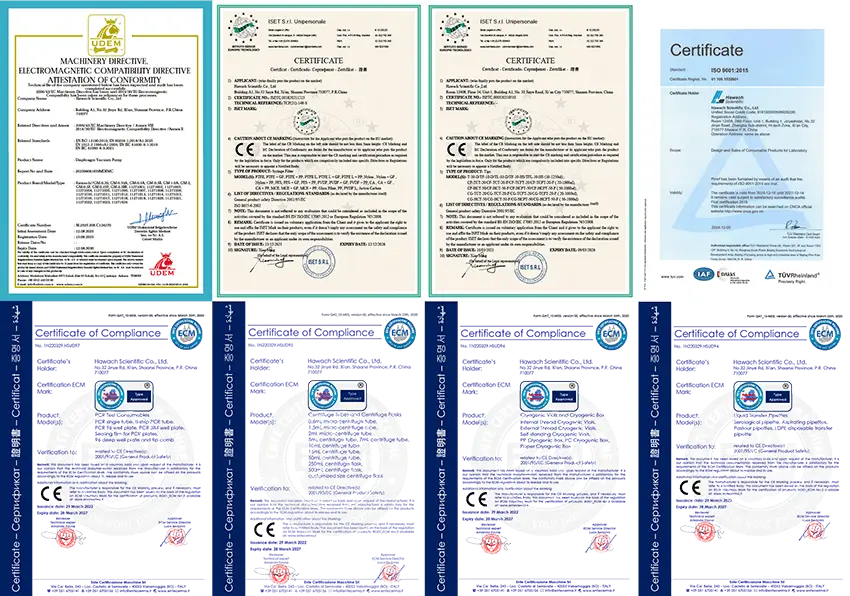

The quality has a guarantee

Fast & safe shipping worldwide