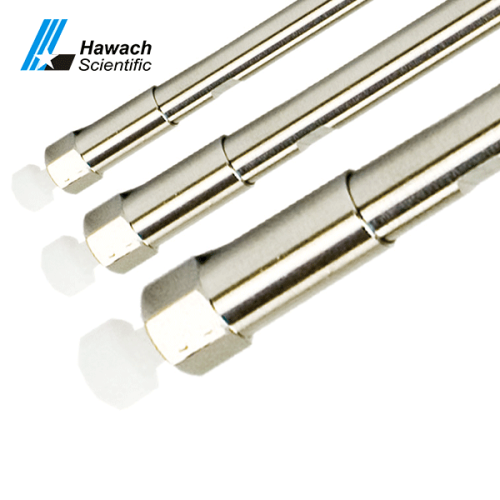
Reverse Phase HPLC Column
Reverse-phase high-performance liquid chromatography (HPLC) column is a widely used chromatographic column for the separation and analysis of various compounds. In reverse-phase HPLC, the stationary phase is nonpolar, while the mobile phase is polar. This setup allows for the separation of polar compounds based on their hydrophobicity.
Reverse-phase HPLC columns are typically packed with nonpolar stationary phases, such as C18 (octadecylsilane), C8 (octylsilane), or phenyl groups bonded to silica or other suitable supports. These stationary phases have hydrophobic properties and interact with nonpolar or weakly polar analytes.
The choice of reverse-phase column depends on the specific application and the analytes of interest.
| Bonded Phase | USP No. | Particle Size (μm) | Pore Size | Surface Area(m2/g) | Carbon loading | pH Range | End-capped | Price |
| C18-Aqueous | L1 | 3,5,10 | 120Å | 320 | 12% | 1.5-10 | YES | |
| C18-Universal | L1 | 1.8,3,5,10 | 120Å | 320 | 17% | 1.5-10 | YES | |
| 300Å | 90 | 8% | ||||||
| C18-Low PH | L1 | 3,5 | 120Å | 160 | 10% | 2.0-8.0 | NO | |
| C18-Alkaline | L1 | 3,5,10 | 120Å | 320 | 17% | 1.5-10 | NO | |
| C8-Universal | L7 | 1.8,3,5,10 | 120Å | 320 | 12% | 1.5-10 | YES | |
| 300Å | 90 | |||||||
| C8-Low PH | L7 | 5 | 120Å | 320 | 5.50% | 1.0-8.0 | NO | |
| C8-Fluorine | L7 | 5 | 120Å | 320 | 12% | 1.5-10 | YES | |
| C1 | L13 | 5 | 120Å | 320 | 4% | 1.5-10 | YES | |
| C4 | L26 | 3,5 | 120Å | 320 | 8% | 1.5-10 | YES | |
| 300Å | 90 | 3% | ||||||
| CN | L10 | 5 | 120Å | 320 | 6% | 1.5-10 | NO | |
| Phenyl | L11 | 3,5,10 | 120Å | 320 | 12% | 1.5-10 | YES | |
| 300Å | 90 | 6% | ||||||
| Phenyl-Ether | / | 5 | 120Å | 320 | 12% | 1.5-10 | YES | |
| Polar RP | L1 | 1.8,3,5,10 | 120Å | 320 | 18% | 1.5-10 | YES | |
| 300Å | 90 | |||||||
| C30 | L62 | 5 | 120Å | 320 | 17% | 1.5-10 | YES | |
| HILIC Amide | / | 5 | 120Å | 320 | 7% | 2.0-8.0 | NO |
Hawach reverse-phase HPLC columns
- C18 Columns: These columns have octadecylsilane bonded to the silica support. They are versatile and suitable for a wide range of applications. C18 columns provide good separation for a variety of analytes, including pharmaceuticals, natural products, and biomolecules.
- C8 Columns: Similar to C18 columns, C8 columns have octylsilane bonded to the silica support. They offer less retention compared to C18 columns and are often used for faster separations or when analytes have weaker hydrophobic interactions.
- Phenyl Columns: Phenyl columns have phenyl groups bonded to the silica support. They provide additional selectivity compared to C18 or C8 columns and are useful for the separation of aromatic compounds, conjugated systems, or compounds with π-electron systems.
- C1 Columns: In reversed-phase chromatography, the stationary phase is nonpolar or hydrophobic, while the mobile phase is typically polar or aqueous. This arrangement allows for the separation of compounds based on their polarity and hydrophobicity. Reversed-phase C1 columns have a stationary phase with C1 alkyl groups, which refers to a carbon chain with a single carbon atom bonded to the silica or polymer surface of the column.
- C4 Columns: Compared to other reverse-phase columns like C18 (octadecyl) columns, C4 columns offer a lower degree of hydrophobicity. This can result in different selectivity and elution order for certain analytes. C4 columns may be preferred in cases where a C18 column might provide excessive retention or undesired selectivity.
- C30 columns: C30 column is a chromatographic column specially designed for the separation of carotenoid isomers. It can separate cis and trans isomers of β-carotene, polar lutein isomers in lutein, and zeaxanthin under the same mobile phase conditions. Carotene can be separated from blood samples, food, and natural product extracts, and can be separated by commercial preparation.
- Cyano Columns: Cyano columns contain cyanopropyl groups bonded to the silica support. They provide different selectivity compared to C18 columns and are particularly useful for separating polar compounds, such as organic acids, amino acids, or carbohydrates.
It’s important to note that the choice of the reverse-phase column depends on factors such as analyte properties, desired separation selectivity, and method requirements. It’s recommended to consult the manufacturer’s guidelines or chromatography experts to select the most appropriate reverse-phase column for a specific analysis.