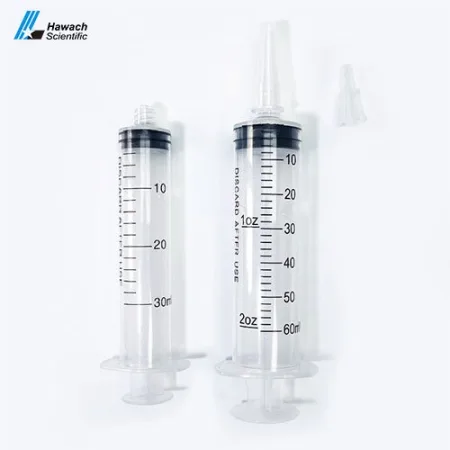
Lab Syringe
A lab syringe, also known as a laboratory syringe or scientific syringe, is a device commonly used in scientific and medical laboratories to measure and transfer precise volumes of liquids. It consists of a barrel, a plunger, and a needle or nozzle.
The barrel of a lab syringe is a transparent tube that is usually made of plastic. It has volume markings along its length, allowing the user to measure the desired quantity of liquid accurately. The plunger is a movable rod or piston that fits tightly within the barrel. By pushing or pulling the plunger, the user can control the flow of liquid into or out of the syringe.
| Item | Description | Volume(mL) | Price |
|---|---|---|---|
| Luer Lock Syringe | Without Needle, Individual Packed | 1 mL, 2 mL, 2.5 mL, 3 mL, 5 mL, 10 mL, 20 mL, 30 mL, 50 mL, 60 mL | |
| Luer Slip Syringe | Without Needle, Individual Packed | 20 mL, 60 mL, 80 mL, 100 mL, 150 mL, 200 mL, 250 mL, 300 mL, 350 mL, 500 mL |
Lab syringes come in various sizes, typically ranging from 20 mL to 500 mL. The needles or nozzles attached to the syringe can also vary in size and shape depending on the specific application. Some syringes may have Luer lock connections, which provide a secure attachment to other devices such as needles, while others may have a simple slip-tip design.
Lab syringes are used in a wide range of scientific and medical procedures. They are commonly used for precise liquid measurements, such as adding reagents or samples to test tubes or cuvettes, transferring liquids between containers, or administering medications or injections in medical settings.
A lab syringe is a precision instrument used in laboratory settings for various applications. It typically consists of a cylindrical barrel with a plunger or piston that allows for controlled and precise fluid dispensing. Here are some features and applications of lab syringes:
Features of Lab Syringe
- Barrel markings: Lab syringes often have clearly marked measurement units, such as milliliters (ml) or microliters (µl), allowing for accurate volume measurements.
- Luer lock tip: Many lab syringes come with a luer lock tip, which ensures a secure and leak-free connection to other devices or instruments like needles, tubing, or adapters.
- Luer slip tip: The term “slip” in the Luer slip tip indicates that the connection relies on friction and pressure rather than a locking mechanism. This means that the fittings can be easily connected and disconnected by simply pushing or pulling them apart.
- Plunger/Handle: The syringe is equipped with a plunger or handle for controlling the movement of the fluid within the barrel. The plunger can be pushed or pulled to dispense or withdraw the liquid.
- Graduations: Graduated markings on the barrel allow for precise measurement and control of the volume of liquids being handled.
- Disposable or reusable: Lab syringes are available in both disposable and reusable forms, depending on the specific requirements of the experiment or procedure.
Applications
- Liquid dispensing: Lab syringes are commonly used to precisely dispense liquids during experiments, such as adding reagents, transferring samples, or preparing solutions with accurate volumes.
- Sample collection: They can be used for sample collection, especially in cases where small volumes are required, such as collecting blood samples or extracting fluids from tissues.
- Chromatography: In chromatographic techniques, lab syringes are used for injecting samples into the chromatography system, delivering precise amounts of the analyte or solvent.
- Cell culture and microinjections: In cell culture applications, syringes are utilized for injecting or withdrawing precise volumes of media, drugs, or other substances into or from cell cultures. They are also used for microinjections into individual cells or small organisms.
- Animal studies: Lab syringes are often employed for dosing animals with substances like medications or experimental compounds in research studies.
- Industrial applications: Syringes find use in various industrial processes, such as filling vials or cartridges with precise volumes of liquids, including pharmaceuticals, chemicals, or adhesives.
It’s important to note that while lab syringes are versatile tools in a laboratory setting, they should be used in accordance with proper safety protocols and waste management practices.