What Should be Paid Attention to When Using Serological Pipettes?
A pipette is a measuring instrument used only to measure the volume of solution it spews, it is a slender glass tube with a large bulge in the middle. The lower end is beak-shaped, and the upper end of the neck is engraved with a marking line, which is a sign of removing the exact volume.
HAWACH is composed of industry professionals with industry backgrounds and rich market experience, providing products for the field of life science research and providing services for the majority of scientific research workers. HAWACH serological pipettes are made of transparent USP grade PS in pure virgin material, mainly used to measure a certain volume of liquid and vacuum suction, and are widely used in tissue culture, bacteriology, clinical, scientific research, and experimentation. The pipette tip is connected to the pipe body by ultrasonic welding, which can reduce the adhesion of the liquid to the pipe wall and improve the sampling accuracy.
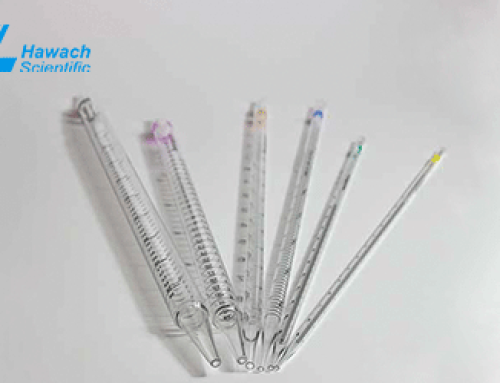
There are different color rings to show different capacities, besides the tube body’s different precision scale marks. By doing so, it is more convenient to use during work; some tube ends are equipped with filter plugs, which can better prevent the occurrence of sample extraction and avoid cross-contamination. There are six different sizes of sterile or non-sterile versions available: 1ml, 2ml, 5ml, 10ml, 25ml, and 50ml. They are colorless and scaleless, easy to observe.
So what should we pay attention to when using serological pipettes?
- Before use:
When using a serological pipette, first look at the pipette mark, accuracy grade, scale position, etc. Before use, wet the oil stains on the inner wall of the pipette with chromic acid lotion. Then rinse the residual lotion with tap water and then with distilled water. There should be no water droplets hanging on the inner wall of the cleaned pipette. Before taking the solution, use filter paper to absorb the water inside and outside the end of the pipette, and then rinse the tube wall with the solution to be taken 2 to 3 times to ensure that the concentration of the solution to be taken remains unchanged. - Liquid suction:
Hold the upper end of the pipette with the thumb and middle finger of the right hand, and insert the lower mouth of the pipette into the liquid to be aspirated. If it is too shallow, it will cause air suction. Aspirate the solution into the ear wash bulb, and smear the solution, if it is too deep, too much solution will stick to the outside of the tube. Hold the ear-washing bulb with the left hand, first empty the ear-washing bulb, then connect the tip of the ball to the upper mouth of the pipette, slowly loosen the flattened ear-washing bulb, and suck the solution into the tube, first suck about 1/3, use Press the mouth of the tube with the index finger of the right hand, take it out, hold it horizontally, and rotate the tube so that the solution is in contact with the upper part of the scale to replace the water in the tube. The inner wall is then drained from the lower opening of the tube and the solution is discarded. After repeated washing 3 times, the solution above the scale can be absorbed, and immediately press the nozzle with the right index finger. - Adjust the liquid level:
Lift the disposable serological pipette up from the liquid level, the end of the pipette is still against the inner wall of the solution container, the pipe body is kept upright, and the index finger is slightly loosened (sometimes the pipette is rotated gently) to make the solution in the tube slowly flow out from the lower mouth until the bottom of the solution meniscus, which is tangent to the marked line, and immediately press the mouth of the tube with the index finger. The drop against the wall is removed, removed from the pipette, and inserted into the container that receives the solution. - Liquid discharge:
If the container holding the solution is a conical flask, tilt the conical flask 30°, the pipette is vertical, the lower end of the pipe is close to the inner wall of the conical flask, loosen the index finger slightly, and let the solution slowly flow down the bottle wall. After all the solution has flowed out, take out the pipette after 15s, so that part of the solution attached to the tube wall flows out. - Avoiding Contamination:
Use a new pipette for each liquid to avoid cross-contamination. Dispose of used pipettes appropriately if handling hazardous or biological materials. Do not touch the pipette tip on any non-sterile surface. - Personal Safety:
Wear appropriate personal protective equipment (PPE), such as gloves, lab coats, and safety goggles, especially when working with hazardous chemicals or infectious materials. Use a pipette aid or controller instead of pipetting by mouth to prevent exposure to potentially harmful substances. - Post-Use Practices:
Dispose of the pipette properly, following laboratory safety and biohazard disposal protocols. Clean the pipette aid or controller after use, especially if working in sterile conditions. - Environmental Conditions:
Avoid extreme temperatures or drafts while pipetting, as these can affect the accuracy of the liquid volume.