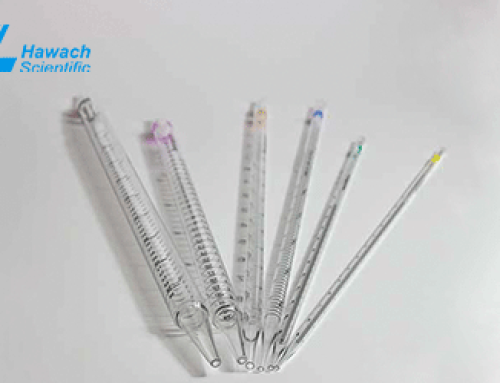
4 Steps to Use the Serological Pipettes Well
According to the volume and requirements of the solution to be transferred, select a suitable pipette for use. Pipettes are generally used to accurately pipette solutions in titration analysis, and pipettes are generally used when the amount of test solution added to the reaction needs to be controlled.
A serological pipette is used to measure the volume of the solution it releases, and is widely used in tissue culture, bacteriology, clinical, scientific research, and other fields that require the aseptic operation to transfer liquids. Commonly used serological pipettes are available in 50ml, 25ml, 10ml, 5ml, 2ml, and 1ml. Produced in 100,000 class cleanroom production condition, HAWACH serological pipette is free of DNase, RNase, and pyrogen. Plus, it provides medical sterilization assurance, with Individual plastic and paper packs for easy application.
HAWACH shows how to use the serological pipette in detail. Here are the main four steps.
1. Check the quality
Firstly check whether the mouth and tip of the pipette are damaged, if they are damaged, they cannot be used; Also we need to check pipette markings, accuracy grades, tick marks positions, etc.


2. Draw the solution
Shake the solution to be absorbed, pour a small part of the solution to be absorbed into a small beaker that is washed and dried, use filter paper to absorb the water inside and outside the cleaned pipette tip, and insert it into the small beaker to absorb the solution. When sucking up to 1/3 of the pipette capacity, immediately press the mouth of the serological pipette with your right index finger, take it out, hold the pipette horizontally and turn the pipette to make the solution flow all over the inner wall of the pipette, and discharge the solution from the tip of the lower end into the waste liquid inside the cup. Doing so, the solution can be aspirated after 3-4 rinses.
Insert the serological pipette rinsed with the liquid to be aspirated 1-2cm below the surface to be aspirated, and use the suction ball to aspirate the solution according to the above operation method (note that the pipette should not be inserted too deep into the solution, and it must be sucked down while sucking). insert, always at this depth). When the liquid level in the tube rises to about 1-2cm above the marking line, quickly block the mouth of the tube with your right index finger (if the solution falls below the standard line at this time, it should be sucked again), and lift the pipette out of the surface to be suctioned. Make the tip of the tube touch the inner wall of the container to be aspirated for a while and then lift it up, and use filter paper to dry off a small amount of solution adhering to the lower end of the pipette or pipette. (When moving the pipette or pipette, the pipette or pipette should be kept vertical and cannot be tilted)
3. Adjust the liquid level
Take another clean small beaker with the left hand, place the tip of the pipette against the inner wall of the small beaker, keep the small beaker tilted, keep the pipette vertical, and keep the scale line and sight level (the left hand cannot touch the pipette). Slightly loosen the index finger (you can rotate the pipette or pipette slightly), so that the solution in the tube slowly flows out from the lower mouth. When the liquid level is approaching the mark, press the right index finger tightly, pause for a while, and then press the upper method to remove the solution. Put the bottom line of the meniscus until it is tangent to the edge of the marking line, and immediately press the nozzle with the index finger. Place the tip against the inner wall of the beaker, move it a little to the beaker’s mouth, and remove the droplets at the tip. Carefully move the pipette or pipette into the container holding the solution.
4. Release the solution
Hold the serological pipette upright, the receiver is inclined, and the lower end of the tube is close to the inner wall of the receiver, release the index finger, to make the solution flow down the receiver’s inner wall. Do not use strong external force to make it flow out, because when calibrating the pipette or pipette, the volume of the solution retained at the inner wall of the tip has been considered.
The above are the steps for using the serological pipette. The operator should strictly follow the above steps to prevent the deviation of the solution measurement due to improper operation.